Before I begin this post, I want to congratulate Crunluath, for successfully identifying the piece the accordion player was performing in our previous post [It was Vivaldi's Four Seasons (Winter)]. As a reward, Crunluath received a delicious bag of Basler Läckerli. En guete! (Enjoy!) I would also like to apologize for the infrequency of our posts. It has been over a month since I last posted. The Swiss Ms. and I have been extremely busy, travelling all over the States (for work and for fun) and we have a huge backlog of posts to upload. So, stay tuned, loyal readers. Much to come! One of things we are very grateful for is that almost everyone here speaks at least some English. A simple "Sprechen Sie Englisch?" and we typically receive the shy response, "A little bit." The conversation that follows is nearly flawless English. I'd be pretty happy if I also spoke a "little bit" of German. Incidentally, we have also found that people are a little bit friendlier to us if we begin with "Grüezi" (a common Swiss-German formal greeting, which is short form of "Gott grüsse Euch", which is "God greets you"). We've found that attempting a little Deutsch (as bad as it is) goes a long way. We are in Switzerland, after all, and we should respect that English is not one of the four officially recognized languages (the four are German, French, Italian and Rumantsch). Despite the prevalence of English, we still get slightly anxious about approaching people here and it has taken us some time to build enough courage to interact with the Swiss. We decided to face our fears on a trip to Oerlikon, a district in the northern part of Zurich, and home to one of the city's biggest farmers markets.
Oerlikon is a very large station, with several major trains, buses and tram lines stopping there.
Oerlikon Farmers' Market: The thing to do on a Saturday morning.
Who wouldn't want to be here? Look at that delectable spread!
Our apartment-mate had requested we buy him some apple cider at the farmers' market. Therefore, we first set out to accomplish the task at hand.
The sign translated to, "Wehntaler's Sweet Cider, freshly pressed." If you bring your own 1.5L bottle, it's 2 francs, and if you need to buy a bottle, it's only 2.50 francs. What a deal!
Since we got one for Kevin and one for ourselves, we both got a chance to dispense our own fresh cider!
Emboldened by our apple cider purchase and the beautiful sunny weather, we decided to buy food for an impromptu picnic in the city.
The Swiss Ms. bravely buying some fresh bread and knuss gipfel (a Swiss hazelnut croissant)
Adding some apples and getrocknete tomaten (dried tomatoes). Didn't know these would be salted and dried.
What meal would be complete without cheese? We bought the Splüga (a cheese from the Splüga region, which is in Southeast of Switzerland) and Formaggio Valle Verzasca (a cheese from Valle Verzasca, a valley in the Canton of Ticino, Switzerland). The Splüga was a soft, mild cheese, while the Valle Verzasca was a hard, more pungent cheese.
With our bounty in hand, we took the tram easily down to Bellevue Platz, a large central square in the heart of Zurich. We headed over by Lake Zurich to chow down on our spoils.
Look at that feast!
To top it off, we visited Café Bar Odeon for some coffee and drinks.
Nothing like a cup of milchkafee (milk coffee) after a picnic!
I decided to go for a mint julep!
The warm, sunny weather beckoned us to explore, so we strolled around the city, going up and down Niederdorf (known as Zurich Lower Village), Bahnhofstrasse (Zurich's main downtown street), and Lindendorf.
A stunning view of the city from Lindenhof, a park in the old town of Zurich on Lindendorf hill, overlooking the Limmat River. The hill gets its name from the tilias (lime tree or Linden tree).
One of the many drinking fountains placed all over Zurich.
A view of the Grossmünster (a Romanesque-style Protestant church). You can climb up the tower and get really great pictures (in a future post!). Note the Swiss Alps in the background.
Next up in our adventures, we went to Basel, which is located in northwest Switzerland on the Rhine River (and also where the Swiss, German and French borders all meet!). Basel is part of the canton of Basel-Stadt (City of Basel), which is actually a half-canton. The other half is Basel-Landschaft (Land of Basel). The separation occurred due to concern over the rights of people in the agricultural areas. These concerns led to the separation of Basel-Landschalt from the city of Basel on August 26th, 1833.
To get to Basel from Thalwil, we took our dependable Inter-Regio to Zurich HB, and then transferred to another completely new type of European train: the Train à Grande Vitesse (TGV)!
The TGV can go faster than 200 mph (320 km/h) when on the correct tracks!
This train goes all the way to Paris! Definitely another place we have on our checklist.
While the train may look empty, many of these seats were reserved from Basel to Paris, which is certainly a popular destination.
A very modern cafe inside the TGV.
We arrived in a speedy 53 minutes, covering about a mile an hour to reach Basel. Three more hours and we could've been in Paris! (The train can run at faster speeds once it crosses into France.)
Very open and grand station.
Certainly felt like one of the larger stations we've visited.
We made our way to the Basel Münster, a cathedral situated right next to the Rhine with Romanesque and Gothic lines. The building is made of red sandstone with colored roof tiles, and listed as a Swiss heritage site of national significance.
The Münster towers over every other structure.
Very grand interior with an organ at the end.
As noted in earlier posts, I am always stunned and awed by the stained glass windows.
Feeling hungry, we took to Altstadt, the medieval Old Town in the heart of Basel. At Marktplatz (marketplace), a bustling farmer's market was filled with delicious and fresh local foods, which we took full advantage of!
Tens of farmers and other producers filling the entire market square with their goods!
We could not resist the delicious looking and smelling bread!
Homemade bread filled with cheese and roasted peppers.
Green and black olive bread, filled with cheese and zucchini!
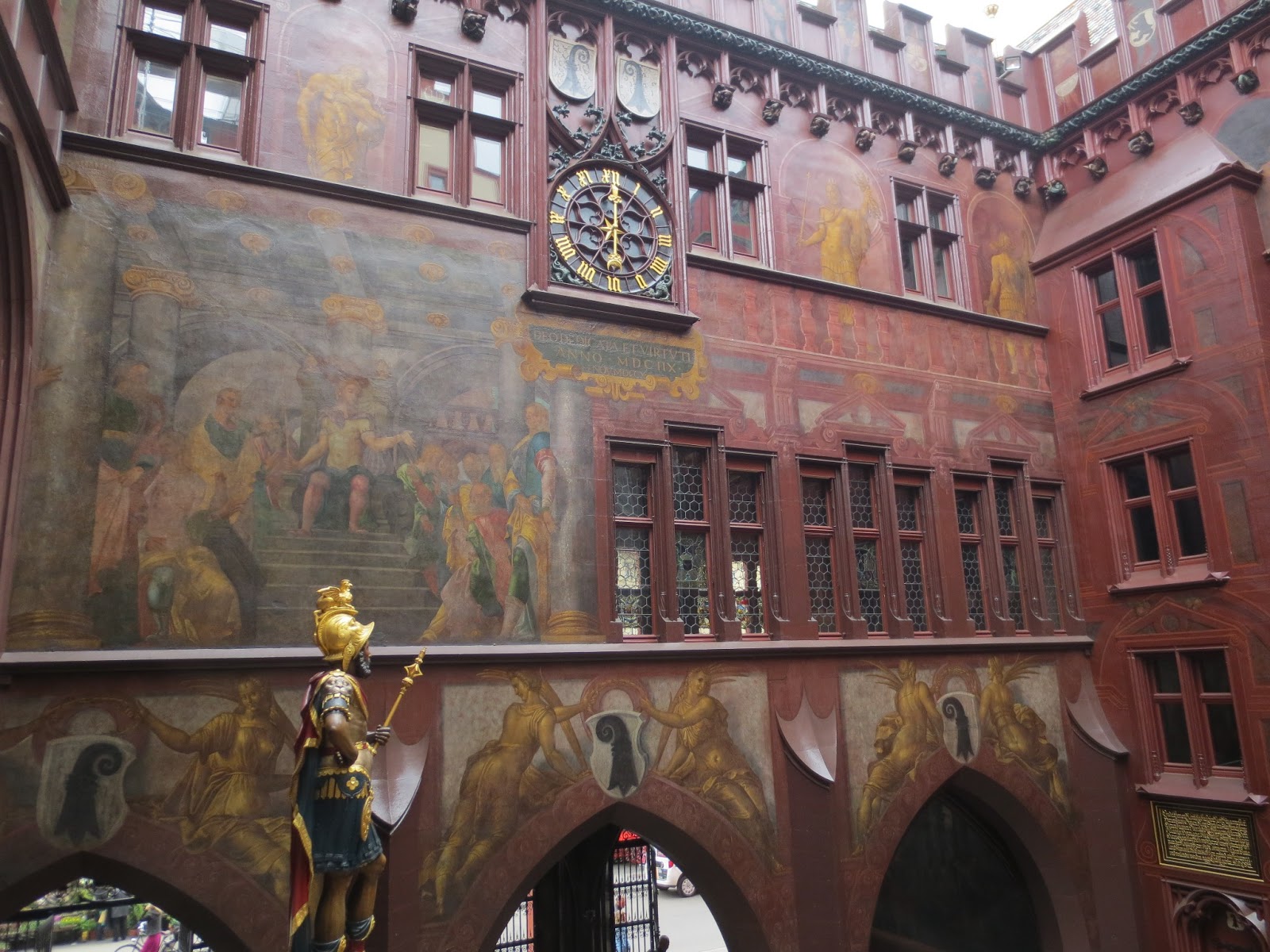
As we ate our bread, we made our way to the Rathaus (City Hall), the seat of government for the Basel-City canton. It definitely stood out with its brilliant red facade, built with Gothic and Renaissance elements. Here, we also saw an amazing street musician perform on his accordion!
Stunning Rathaus stands out at Marktplatz.
Interior is ornately decorated and just as vibrantly colored.
Can you name the piece he is playing? One correct comment will be randomly chosen to receive a prize!
We continued to explore Altstadt, visiting the Spalentor city gate, (about 400 meters west of Marktplatz) one of the three gates to survive the wall's demolition. Unfortunately, it was under renovation when we visited, so we'll have to come again when it's finished. It was also very pleasant to stroll down the many narrow lanes to gaze on the centuries-old houses in Basel.
A gentle stroll on the historic streets between Marktplatz and Spalentor.
I think our bagpiping readers would appreciate this. Happy Father's Day!
Since I like eating and am constantly hungry, we decided to linger at one of the many cafes in Basel for lunch.
Very happy (Ms: or creepy!) with her Latte Macchiato (typically a three layer drink, with milk on the bottom, a shot of espresso in the middle and milk foam on top).
Me with my Cafe Lungo (Italian for long). Similar to an espresso, but twice as much water is used to make the drink, resulting in a stretched espresso, or lungo.
Spicy salami panini oozing with mozzarella cheese, grilled to a golden brown.
Fortified with (more) food, we made our way to the Kunstmuseum (art museum) in Basel to see the Picasso exhibit! We could not take any pictures in the exhibit, but it was definitely worth the trip and made me appreciate the diverse talents of this artist. We also got admission to the rest of the museum, so we were able to look at other wonderful works of art by Monet, Cézanne, van Gogh, Renoir, and many many more.
Very much worth the visit!
After a very busy day, we decided to go back home, but not after getting some of the famous Basler Läckerli, a traditional hard spice biscuit (recipe over 700 years old!) created by local spice merchants and made with honey, hazelnuts, candied citrus peel and Kirsch (a fruity brandy, made from distilling cherries).
Packages of this stuff go quickly!
They even have different flavors. Extra candied lemon peels are used in this one.
Basler Läckerli!
More adventures coming up (and quicker updates too!)
-Herr Cervelat
Sorry for the delay in posts. Typically, we're good about it, but the Swiss Ms has left for the United States, leaving me all alone in Zurich. Instead of travelling, I've been spending most of my time in lab for the sake of science. However, despite not travelling, we have quite a backlog of expeditions that I need to post for our faithful readers! In early May, we realized that we had not taken advantage of the large amounts of cheese in the area. Sure, we've bought some cheese at the grocery store, but we wanted to taste the cheese from its source! We decided to go to Appenzellerland and visit the Appenzell Cheese Factory, located in a remote region in Northeast Switzerland. Appenzellerland is actually divided into two half-cantons (Appenzell Innerrhoden and Appenzell Ausserrhoden), and is usually referred to as die beiden Appenzell (the two Appenzells). The reason for this division was religious, with Ausserrhoden being Protestant and Innerrhoden remaining Catholic.
The coat of arms for Appenzellerland. (Children should avert their eyes...)
Unlike the other regions we have visited, there were no direct forms of transportation to Appenzellerland. In fact, a one-way trip took us nearly two hours!
A one-way trip planned by the good people at the Thalwil train station. They even gave us a print-out to help us out! So courteous!
We first went south from Thalwil along Lake Zurich to Pfaffikon on the S2. There, we transferred onto a totally new type of train: the Voralpen Express!
There it is!!! A new train!
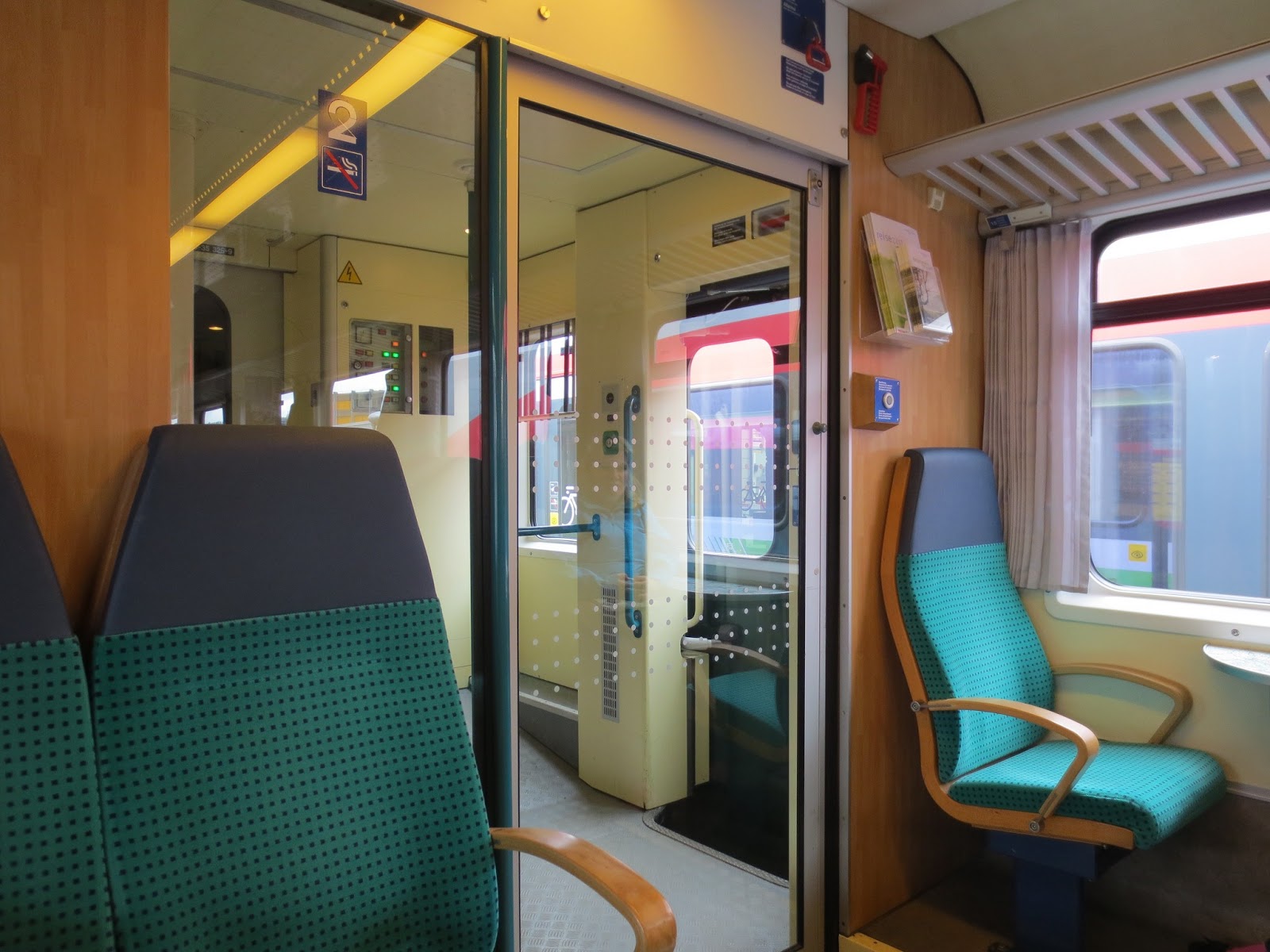
It feels like I'm riding in a chalet with big windows and real wood paneling. The train also made melodious sounds to inform passengers when it was about to arrive at a new stop.
The red line indicates the route of the Voralpen express. It goes from Lucerne to Romanshorn (without going through Zurich HB), passing St. Gallen on the way!
Despite the Voralpen journey taking about an hour and a half, it was very scenic and pleasant, so the time seemed to fly by!
Beautiful rolling hills.
Cows cows cows.
We arrived at Herisau, a small town in the canton of Appenzell Ausserrhoden, where we needed to transfer to a bus line that is run by Die Post (The Swiss Postal Service) to the Appenzell Cheese Factory. The Appenzellerland region is not serviced by the the SBB, so Die Post came in to run the public transportation for the area. I think it has to do with the fact that the area has many hills and is very rural.
Thank goodness for Die Post! Without it, we would have some trouble getting to the factory!
We had to take a bus from Herisau to Stein AR, Post, another 16 minute journey to get to our destination. After nearly two hours of travel, this cheese factory had better be open.
We're finallyhere. S2 => Voralpen Express => Post Bus
The long journey has made her hungry!
It was open! We walked inside, and immediately we were assaulted by the smell of cheese fermenting. Very intense. As we wandered around, a nice employee approached us. The conversation went something like this. Appenzeller Factory Employee: What would you like to do here? Me: Eat. (Silence.) Swiss Ms: Um...I think he wants to go to the restaurant. Appenzeller Factory Employee: Restaurant is right this way. I think the Swiss Ms was less than impressed with my monosyllabic answer and attempted to make it more meaningful (Swiss Ms: More like polite). I was hungry. Fortunately, the restaurant was open.
The restaurant features cheese made right in the factory.
Cozy interior feels like I'm inside a mountain chalet.
And then, the food!
A delightful plate of Appenzeller cheese! Starting from the upper left, we have the: (1) Classic, (2) Bio (Organic), (3) Surchoix (very good), (4) Extra (very very good), (5) some fig/fruit thing and (6) quarter Fett Rass (awful).
The Original Appenzeller Toast: ham and pears on toasted bread, topped with melted Raclette (another Swiss cheese) and Appenzeller cheese (I think it was the Surchoix).
Fully fed, we moved onto the factory tour and we saw the cheese being made!
Where the cheese making magic happens!
So. Much. Milk.
Preparing to make the cheese.
So. Much. Cheese.
We learned that the cheese is seasoned with a brine of secret alpine herbs that gives it a spicy flavor. (The Swiss say spicy, but I think we might call it sharp.) If I'm not mistaken, each one of the wheels of cheese is still individually rubbed with the seasoning. The cows graze on the rolling green meadows to give them the highest quality milk. Such care! No wonder it tastes so good (except the Fett Rass...this is the aged reduced fat cheese). We made our way to the neighboring museum to witness how cheese making was done before it was all industrialized!
The cheesmaker started with 65 liters of full cream raw milk (from happy cows!). They added 5 - 6 liters of warm water with dry bacteria cultures. It was heated to 32 degrees Celsius (90 Fahrenheit), then simmered for 1 hour. Rennet (Curdled milk from the stomach of an unweaned calf) was added to curdle the milk. The resulting mixture was cut up with a cheese harp to make small identical pieces of curd. Finally, about 10 liters of whey (liquid remaining after milk had curdled) was replaced with warm water, "washing the curd" to dilute the lactose.
The man uses cheese cloth to pick up the curd (two hands and his mouth make a triangular net) to pick it up!
Look at all that curd!
Close up of the curd! No gloves.
The curd is lightly pressed to remove excess whey.
The curd is sectioned off to nine pieces and placed into a mold. The cheese is pressed and turned over several times a day. The following day, the cheese is put in a salt bath for conservation. Then, it is stored in a cheese cellar and brushed with seasoning until ripened to perfection!
Before we left, we decided to take some of Appenzellerland with us!
Yum! Our favorite cheese from our lunch cheese platter.