Next up in our adventures, we went to Basel, which is located in northwest Switzerland on the Rhine River (and also where the Swiss, German and French borders all meet!). Basel is part of the canton of Basel-Stadt (City of Basel), which is actually a half-canton. The other half is Basel-Landschaft (Land of Basel). The separation occurred due to concern over the rights of people in the agricultural areas. These concerns led to the separation of Basel-Landschalt from the city of Basel on August 26th, 1833.
To get to Basel from Thalwil, we took our dependable Inter-Regio to Zurich HB, and then transferred to another completely new type of European train: the Train à Grande Vitesse (TGV)!
The TGV can go faster than 200 mph (320 km/h) when on the correct tracks!
This train goes all the way to Paris! Definitely another place we have on our checklist.
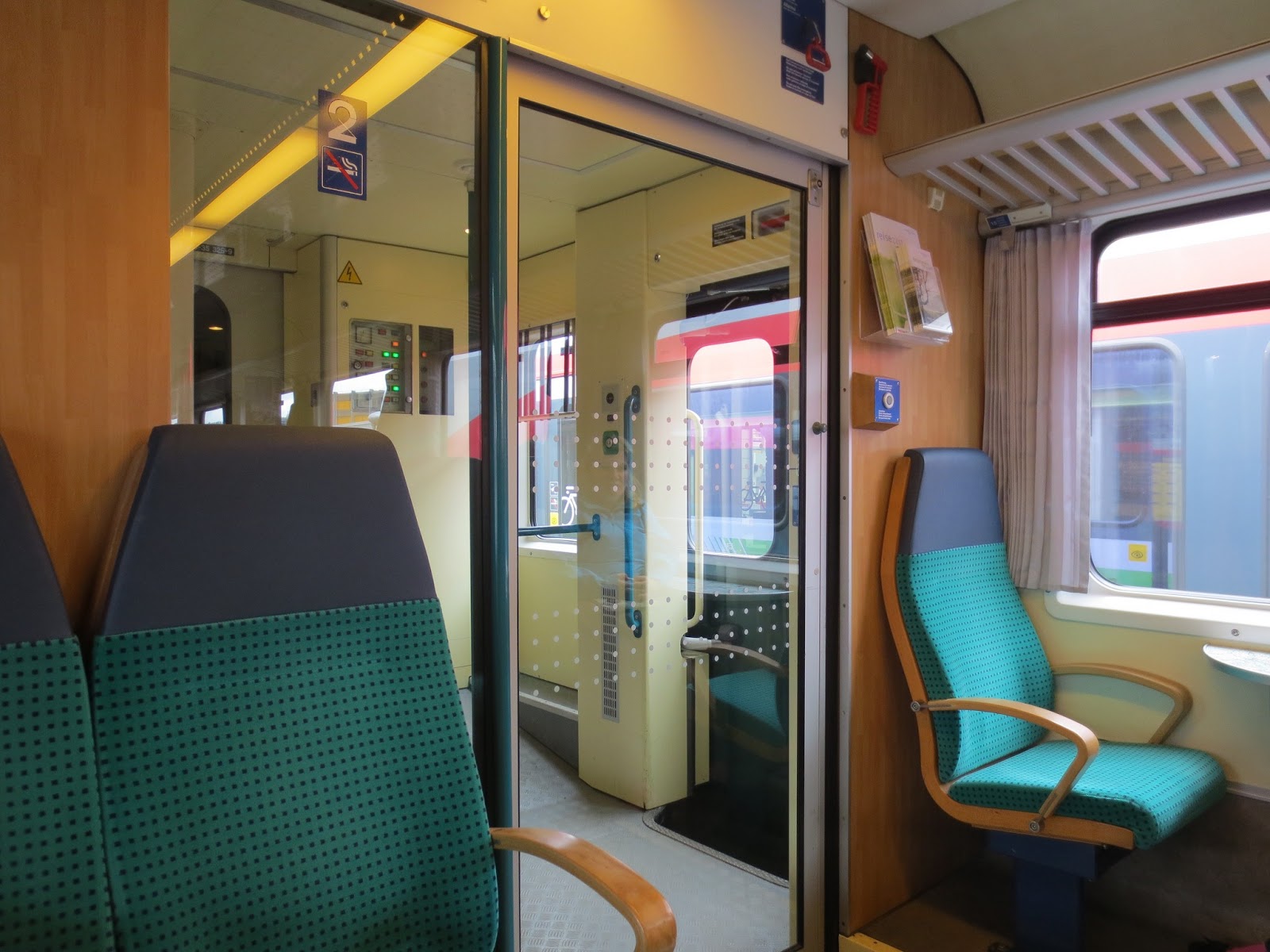
While the train may look empty, many of these seats were reserved from Basel to Paris, which is certainly a popular destination.
A very modern cafe inside the TGV.
We arrived in a speedy 53 minutes, covering about a mile an hour to reach Basel. Three more hours and we could've been in Paris! (The train can run at faster speeds once it crosses into France.)
Very open and grand station.
Certainly felt like one of the larger stations we've visited.
We made our way to the Basel Münster, a cathedral situated right next to the Rhine with Romanesque and Gothic lines. The building is made of red sandstone with colored roof tiles, and listed as a Swiss heritage site of national significance.
The Münster towers over every other structure.
Very grand interior with an organ at the end.
As noted in earlier posts, I am always stunned and awed by the stained glass windows.
Feeling hungry, we took to Altstadt, the medieval Old Town in the heart of Basel. At Marktplatz (marketplace), a bustling farmer's market was filled with delicious and fresh local foods, which we took full advantage of!
Tens of farmers and other producers filling the entire market square with their goods!
We could not resist the delicious looking and smelling bread!
Homemade bread filled with cheese and roasted peppers.
Green and black olive bread, filled with cheese and zucchini!
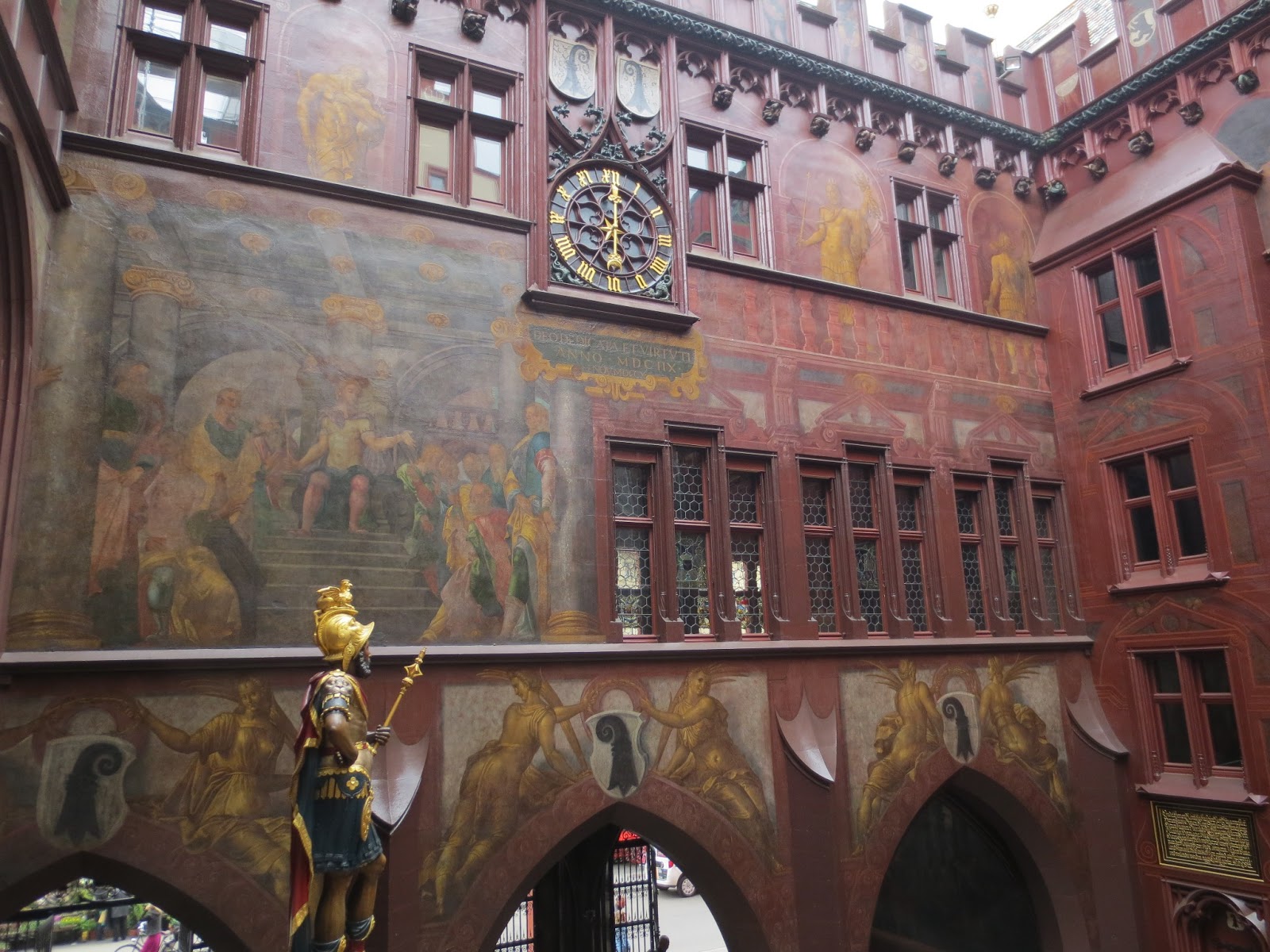
As we ate our bread, we made our way to the Rathaus (City Hall), the seat of government for the Basel-City canton. It definitely stood out with its brilliant red facade, built with Gothic and Renaissance elements. Here, we also saw an amazing street musician perform on his accordion!
Stunning Rathaus stands out at Marktplatz.
Interior is ornately decorated and just as vibrantly colored.
Can you name the piece he is playing? One correct comment will be randomly chosen to receive a prize!
We continued to explore Altstadt, visiting the Spalentor city gate, (about 400 meters west of Marktplatz) one of the three gates to survive the wall's demolition. Unfortunately, it was under renovation when we visited, so we'll have to come again when it's finished. It was also very pleasant to stroll down the many narrow lanes to gaze on the centuries-old houses in Basel.
A gentle stroll on the historic streets between Marktplatz and Spalentor.
I think our bagpiping readers would appreciate this. Happy Father's Day!
Since I like eating and am constantly hungry, we decided to linger at one of the many cafes in Basel for lunch.
Very happy (Ms: or creepy!) with her Latte Macchiato (typically a three layer drink, with milk on the bottom, a shot of espresso in the middle and milk foam on top).
Me with my Cafe Lungo (Italian for long). Similar to an espresso, but twice as much water is used to make the drink, resulting in a stretched espresso, or lungo.
Spicy salami panini oozing with mozzarella cheese, grilled to a golden brown.
Fortified with (more) food, we made our way to the Kunstmuseum (art museum) in Basel to see the Picasso exhibit! We could not take any pictures in the exhibit, but it was definitely worth the trip and made me appreciate the diverse talents of this artist. We also got admission to the rest of the museum, so we were able to look at other wonderful works of art by Monet, Cézanne, van Gogh, Renoir, and many many more.
Very much worth the visit!
After a very busy day, we decided to go back home, but not after getting some of the famous Basler Läckerli, a traditional hard spice biscuit (recipe over 700 years old!) created by local spice merchants and made with honey, hazelnuts, candied citrus peel and Kirsch (a fruity brandy, made from distilling cherries).
Packages of this stuff go quickly!
They even have different flavors. Extra candied lemon peels are used in this one.
Basler Läckerli!
More adventures coming up (and quicker updates too!)
-Herr Cervelat
Sorry for the delay in posts. Typically, we're good about it, but the Swiss Ms has left for the United States, leaving me all alone in Zurich. Instead of travelling, I've been spending most of my time in lab for the sake of science. However, despite not travelling, we have quite a backlog of expeditions that I need to post for our faithful readers! In early May, we realized that we had not taken advantage of the large amounts of cheese in the area. Sure, we've bought some cheese at the grocery store, but we wanted to taste the cheese from its source! We decided to go to Appenzellerland and visit the Appenzell Cheese Factory, located in a remote region in Northeast Switzerland. Appenzellerland is actually divided into two half-cantons (Appenzell Innerrhoden and Appenzell Ausserrhoden), and is usually referred to as die beiden Appenzell (the two Appenzells). The reason for this division was religious, with Ausserrhoden being Protestant and Innerrhoden remaining Catholic.
The coat of arms for Appenzellerland. (Children should avert their eyes...)
Unlike the other regions we have visited, there were no direct forms of transportation to Appenzellerland. In fact, a one-way trip took us nearly two hours!
A one-way trip planned by the good people at the Thalwil train station. They even gave us a print-out to help us out! So courteous!
We first went south from Thalwil along Lake Zurich to Pfaffikon on the S2. There, we transferred onto a totally new type of train: the Voralpen Express!
There it is!!! A new train!
It feels like I'm riding in a chalet with big windows and real wood paneling. The train also made melodious sounds to inform passengers when it was about to arrive at a new stop.
The red line indicates the route of the Voralpen express. It goes from Lucerne to Romanshorn (without going through Zurich HB), passing St. Gallen on the way!
Despite the Voralpen journey taking about an hour and a half, it was very scenic and pleasant, so the time seemed to fly by!
Beautiful rolling hills.
Cows cows cows.
We arrived at Herisau, a small town in the canton of Appenzell Ausserrhoden, where we needed to transfer to a bus line that is run by Die Post (The Swiss Postal Service) to the Appenzell Cheese Factory. The Appenzellerland region is not serviced by the the SBB, so Die Post came in to run the public transportation for the area. I think it has to do with the fact that the area has many hills and is very rural.
Thank goodness for Die Post! Without it, we would have some trouble getting to the factory!
We had to take a bus from Herisau to Stein AR, Post, another 16 minute journey to get to our destination. After nearly two hours of travel, this cheese factory had better be open.
We're finallyhere. S2 => Voralpen Express => Post Bus
The long journey has made her hungry!
It was open! We walked inside, and immediately we were assaulted by the smell of cheese fermenting. Very intense. As we wandered around, a nice employee approached us. The conversation went something like this. Appenzeller Factory Employee: What would you like to do here? Me: Eat. (Silence.) Swiss Ms: Um...I think he wants to go to the restaurant. Appenzeller Factory Employee: Restaurant is right this way. I think the Swiss Ms was less than impressed with my monosyllabic answer and attempted to make it more meaningful (Swiss Ms: More like polite). I was hungry. Fortunately, the restaurant was open.
The restaurant features cheese made right in the factory.
Cozy interior feels like I'm inside a mountain chalet.
And then, the food!
A delightful plate of Appenzeller cheese! Starting from the upper left, we have the: (1) Classic, (2) Bio (Organic), (3) Surchoix (very good), (4) Extra (very very good), (5) some fig/fruit thing and (6) quarter Fett Rass (awful).
The Original Appenzeller Toast: ham and pears on toasted bread, topped with melted Raclette (another Swiss cheese) and Appenzeller cheese (I think it was the Surchoix).
Fully fed, we moved onto the factory tour and we saw the cheese being made!
Where the cheese making magic happens!
So. Much. Milk.
Preparing to make the cheese.
So. Much. Cheese.
We learned that the cheese is seasoned with a brine of secret alpine herbs that gives it a spicy flavor. (The Swiss say spicy, but I think we might call it sharp.) If I'm not mistaken, each one of the wheels of cheese is still individually rubbed with the seasoning. The cows graze on the rolling green meadows to give them the highest quality milk. Such care! No wonder it tastes so good (except the Fett Rass...this is the aged reduced fat cheese). We made our way to the neighboring museum to witness how cheese making was done before it was all industrialized!
The cheesmaker started with 65 liters of full cream raw milk (from happy cows!). They added 5 - 6 liters of warm water with dry bacteria cultures. It was heated to 32 degrees Celsius (90 Fahrenheit), then simmered for 1 hour. Rennet (Curdled milk from the stomach of an unweaned calf) was added to curdle the milk. The resulting mixture was cut up with a cheese harp to make small identical pieces of curd. Finally, about 10 liters of whey (liquid remaining after milk had curdled) was replaced with warm water, "washing the curd" to dilute the lactose.
The man uses cheese cloth to pick up the curd (two hands and his mouth make a triangular net) to pick it up!
Look at all that curd!
Close up of the curd! No gloves.
The curd is lightly pressed to remove excess whey.
The curd is sectioned off to nine pieces and placed into a mold. The cheese is pressed and turned over several times a day. The following day, the cheese is put in a salt bath for conservation. Then, it is stored in a cheese cellar and brushed with seasoning until ripened to perfection!
Before we left, we decided to take some of Appenzellerland with us!
Yum! Our favorite cheese from our lunch cheese platter.
While it has been exciting exploring different areas of Switzerland, we have to admit we haven't checked-out Zurich thoroughly. Our initial plan was to go to a very well recommended restaurant, Alpenrose, just north of Zurich HB in Kreisboro 5. Zurich is divided into twelve districts (Kreis). (Sounds like the Hunger Games.) We were aiming to go for a nice Saturday brunch, but when we got there, they were not open! It seems that on Samstag und Sonntag (Saturday and Sunday), they are only open for Abendessen (dinner).
So, we ended up going to Migros instead for lunch, which was fantastic! For those of you who know about Wegmans, we feel that Migros is the Swiss' Wegmans. Like Wegmans, Migros does not sell cigarettes (or alcohol). However, some retailers acquired by Migros such as Denner (think discount Migros) do sell them. The Swiss Ms. continues to prefer Migros over Coop.
Migros is continuing to win her heart (and her stomach). Almost as good as the food bars at Weggies!
I thought that by getting food at Migros, it would be much cheaper than eating out. WRONG. This plate of food cost me about 22 CHF. If you felt how heavy it was that would probably make sense.
We then made our way to the Landesmuseum (Swiss National Museum) and had a great time learning about Swiss history. Rather than take post pictures of the entire museum (you wouldn't want that), I found two parts of the museum very interesting. Swiss Money
The money really embodies Swiss culture. It is incredibly thoughtful and makes a lot of sense.
The evolution of Swiss Money. The money in circulation is the bottom row. Note how the size of the bill gets bigger with larger values: the size of the 1000 CHF is larger than the 10 CHF.
1000 CHF!!! Who would carry that around with them? Note the triangle on the left side of the bill. There is a unique indent to help distinguish the different bills' denominations (i.e. 10 CHF has a dotted circle, 20 CHF has a dotted square). This feature, in addition to the bill size, is an aid for the sight impaired.
At values below 10 CHF, there are the 5, 2, 1 and 1/2 CHF coins, which all scale in weight! (i.e. 5 CHF is 5 times heavier than the 1 CHF coin, 2 CHF coin is four times heavier than the 1/2 CHF). Then there are the 20 and 10 rappen coins. The five rappen coin (not pictured) is the smallest of all and the color of a penny.(100 rappen = 1 CHF)
Terrestrial Globe On our visit to St. Gallen, we learned that there was quite a fierce religious war in 1712 between the Canton of Zurich (Protestants) and Saint-Gall (Catholics). As such, many cultural objects that previously belonged to the Abbey Library (which we visited), were transferred to Zurich. Later on in 1718, Zurich agreed to return most of the cultural objects taken from Saint-Gall, except for some 100 items (manuscripts, books, paintings) and most importantly, Prince-Abbot Bernhard Muller’s cosmographical Globe (pictured below). Saint-Gall asked for the rest of the cultural objects, but Zurich denied taking them, and the globe remained at the National Museum.
Fast forward to the year 1996, the issue of unclaimed cultural objects is brought up again, and the public becomes involved. Eventually, by 2006, settlement between Zurich and Saint-Gall was reached through outside mediation. In the end, Saint-Gall accepted Zurich's ownership of the cultural objects at the National Museum, Zurich indefinitely loaned some manuscripts to Saint-Gall, and most importantly, Zurich commissioned a copy of the Globe at its own expense and donated it to Saint-Gall. For more information, you can go here.
The original globe sitting in the Swiss National Museum at Zurich. We couldn't take a picture of the copy when we were at the Abbey in St. Gallen, so we're excited to show you!
Saint-Gall welcomed its copy into the Abbey with a celebration in August 2009.
After our museum experience, we decided to treat ourselves with a delicious cup of hot chocolate at Sprüngli, a Swiss luxury confectionery on Bahnhofstrasse.
Right on Bahnhofstrasse (Zurich's main downtown street, think NYC's Fifth Avenue). Home of delicious hot chocolate and other tasty treats.
Typically at restaurants in America, you would get complementary tap water with your meal by request. Not in Switzerland. Water is typically not given out, and only available for purchase. The only instances we received water were when we ordered coffee and a small glass (4oz or less) was given as a palate cleanser. Additional glasses at 1 CHF each.
The next day, we decided to continue our adventure of Zurich, but instead of taking the train to Zurich...we took a boat!
The ticket from Thalwil to Zurich covers all means of transportation, including this boat. Behold the good ship Albis.
Fully catered with getränke (drinks) and food!
Happy to be on a boat cruise on a Sunday morning.
Enjoying a cup of espresso as we travel up Lake Zurich to Bürkliplatz.
Once we arrived at Burkliplatz, we noticed another, much larger ship filled with people. We learned that every Sunday, there is a brunch buffet cruise that leaves Burkliplatz and circumnavigates Lake Zurich on a relaxing 2 1/2 hour cruise! We decided that we would save it for another time and hopped over to cafe Odeon for Sunday brunch (and unlike Alpenrose, it was open!)
According to Wikipedia, Cafe Odeon has the reputation of being an intellectual meeting place. Some famous visitors include Albert Einstein, James Joyce, Lenin and Mussolini. When we're famous, Wikipedia will add our names to that list.
My Rösti, a Swiss dish of grated potatoes, with two gooey eggs and loads of cheese. The conversation may not have been overly intellectual, but it was just the right speed for a Sunday morning.